Defining [Serious] Games
What is a Game?
First things first….
Surprisingly, there is not an exact definition for the word game. In fact, to get an idea of how inconvenient this is, there are over 50 definitions that claim to define the word “game.” Within all the definitions and the ones that continue to be added to the realm there is something that stands out about them; this is that some factors are recognized to be common within all game definitions. Because of the idea of sharing common grounds, to me, what defines a game is the nature of the given concept and its characteristics.
The article, “The Game Definition Game: A Review “by Jaakko Stenros shares many game definitions while analyzing them. Among those definitions, there is a list of seven elements that were initially introduced by Elliott Avedon in 1971. According to the list, for something to be regarded as a game it must have (1) a purpose, (2) as well as include procedures for action and (3) rules governing action. Additionally, a game must have a (4) number of required players (one or more active participants), (5) the roles of the participant, (6) participant interaction patterns, and (7) results (Stenros, 2016).
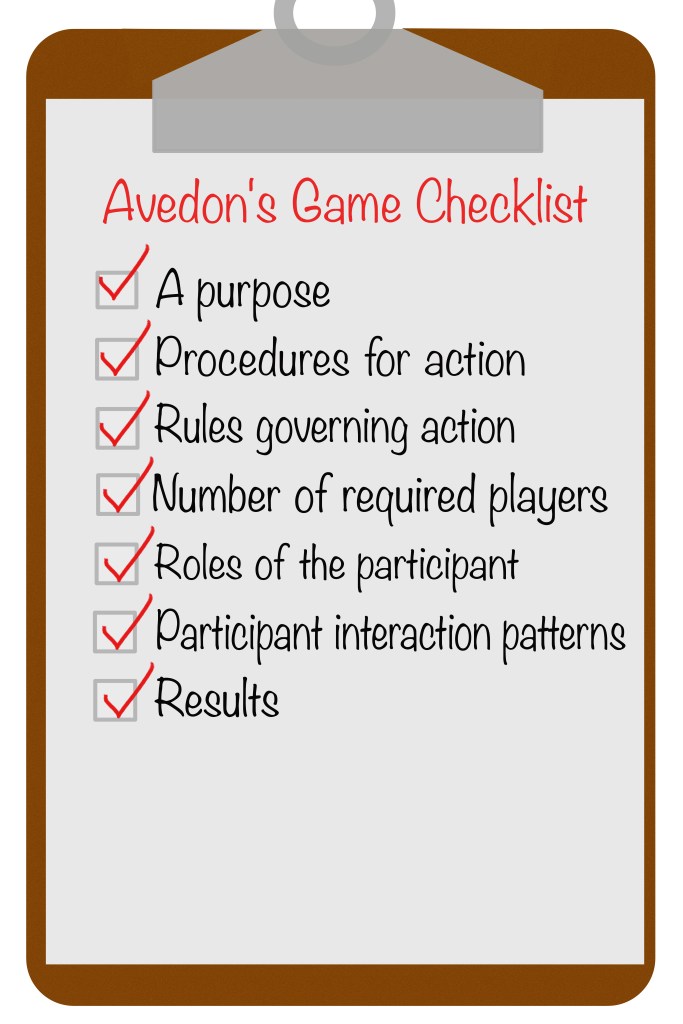
Based on the games that I have played in my lifetime, I would consider the list a perfect description of what a game consists of. I am aware that it is not formatted like an actual definition. However, since there is not an exact definition for the word “game”,this could be used as a checklist when debating whether a concept should be regarded as one.
The idea of using a checklist instead of an exact definition gives us the freedom to choose not only what qualifies as a game but it also helps when categorizing games. There are many different types of games varying on themes, objectives, platforms, genre, etc. Later on, we will see how the checklist could be used to identify and categorize a specific type of game.
Serious Game Definition
The definition of a serious game draws out the elements of a game provided above. For a game to be serious, you would have to add the components that make it serious. Right? In addition to the elements stated by Avedon, there are specific factors that, in combination, contribute to the definition of serious games.
Now, when I first heard of serious games, it was recently, when I had signed up for the class. The first thing that came to my mind was, “How can a game be possibly ‘serious’? A game is a game. It is meant to be playful and fun. ” I am sure I am not the only that has that reaction when hearing the word serious as an adjective to the noun “game”, for sure. However, I have come to learn that the word serious is not meant to take away the “fun” part that we expect from games. On the contrary, it proves a game can be utilized for more than just mere entertainment.
I have concluded that what makes a serious game, “serious,” is its design and well-crafted goal to teach. That is, a serious game is a well-rounded game meant to teach a player a specific lesson, depending on its theme. Serious games are designed to help improve performance in real-life situations resulting from the completion of a specific objective.
For instance, these games are applied in different fields, such as management, education, military, and sales. Serious games are life-skills games. Serious games are designed to demonstrate the progress of a player(s) in different areas that are expected to result the following learning outcomes: cognitive, motor skills, affective, and or communicative (Wouters, Spek, & Oostendorp, 2009).
Identifying a Serious Game
The Control of the Cell Cycle
The “Control of the Cell Cycle” game is found on “The Nobel Prize” and it is described per the website below:
The game is about the different phases in ordinary cell division, mitosis. Between each phase there several “check points” to make sure that nothing happened to the genetic on the way.
In this page you can choose to either be redirected to a more detailed and in-depth description of the game, to start the game, “help” regarding how to play the game, or information about the Nobel Prize. I chose to start the game right away.
Based on my definition of a serious game in combination of the characteristics that make up a game, I was able to recognize “The Control of the Cell” as a serious game. This is how!
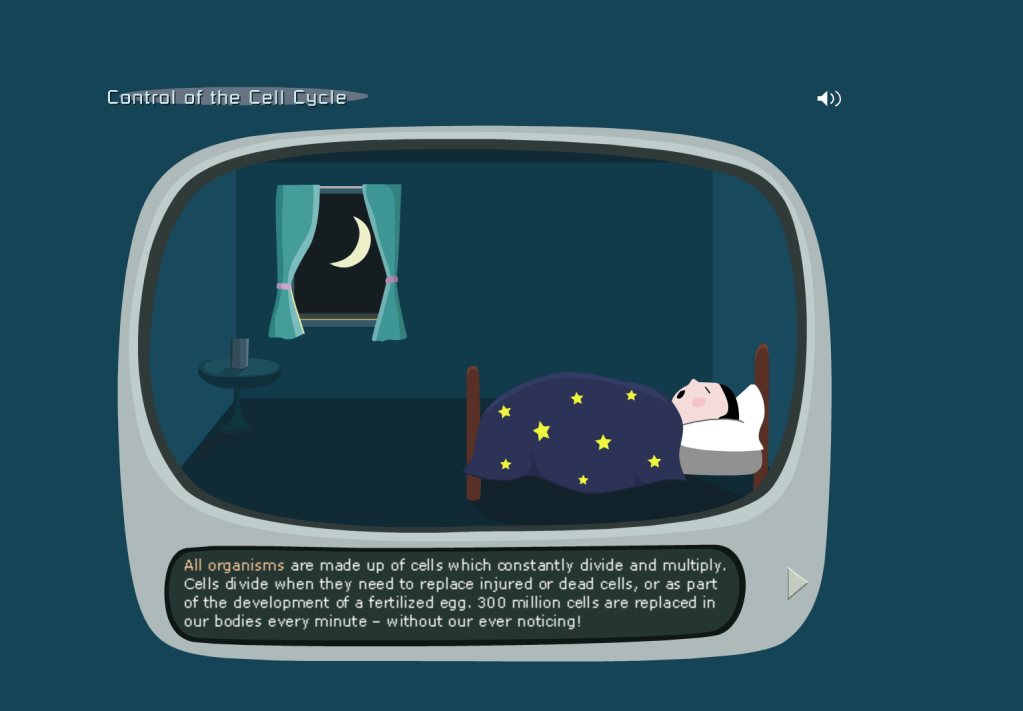
Revisiting Avedon’s Checklist, I first identified the purpose of the game. From the title and the description we can tell that the game is about mitosis and we will be learning about the cell cycle.
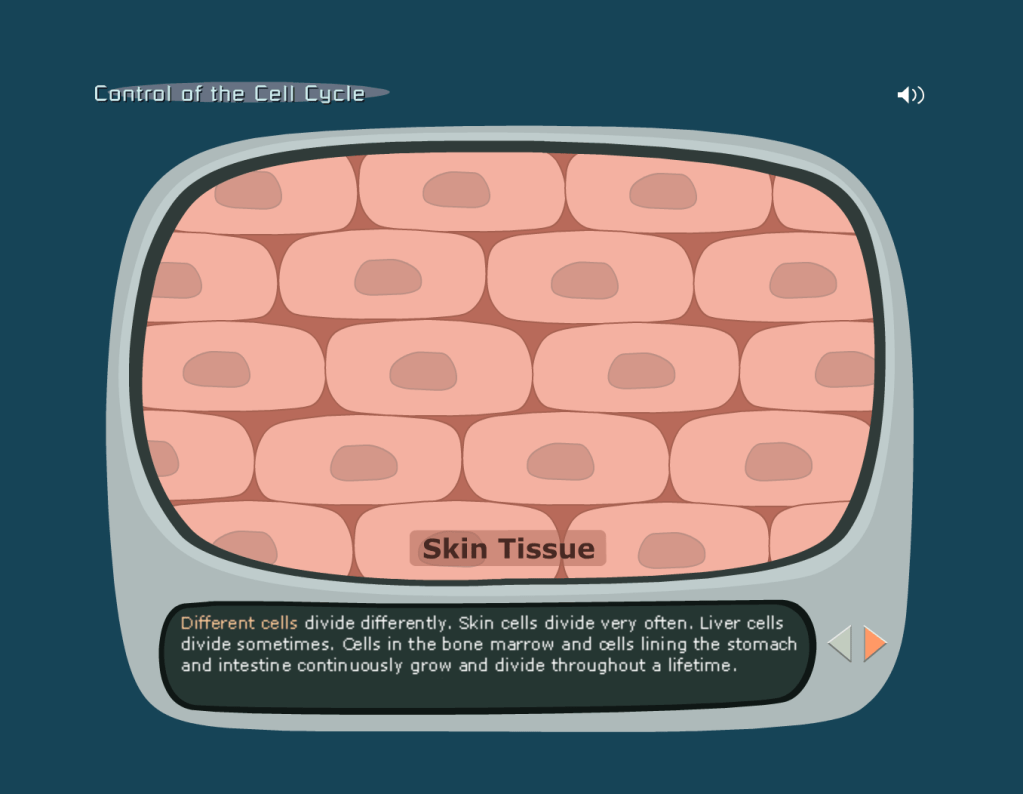
The storyline starts up with a boy laying down in bed and continues developing by explaining that we have different cells in our bodies.
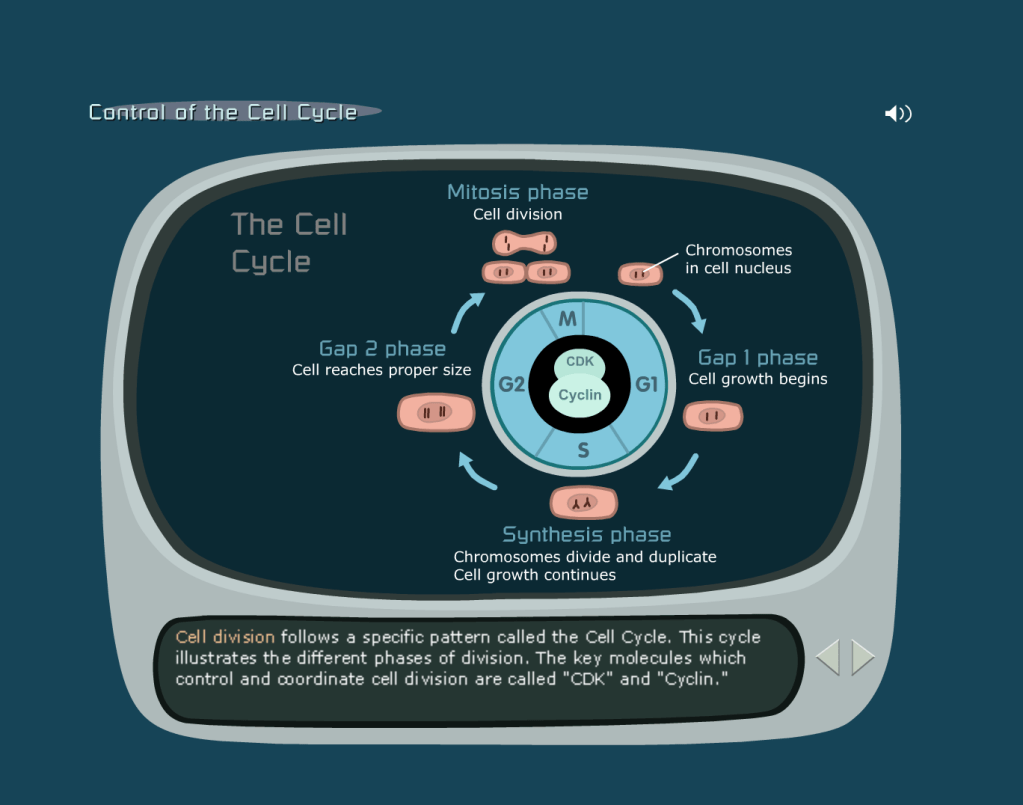
Through the storyline, we get to learn about the cell cycle and what each phase represents. We are also introduced with new terms as we go along.
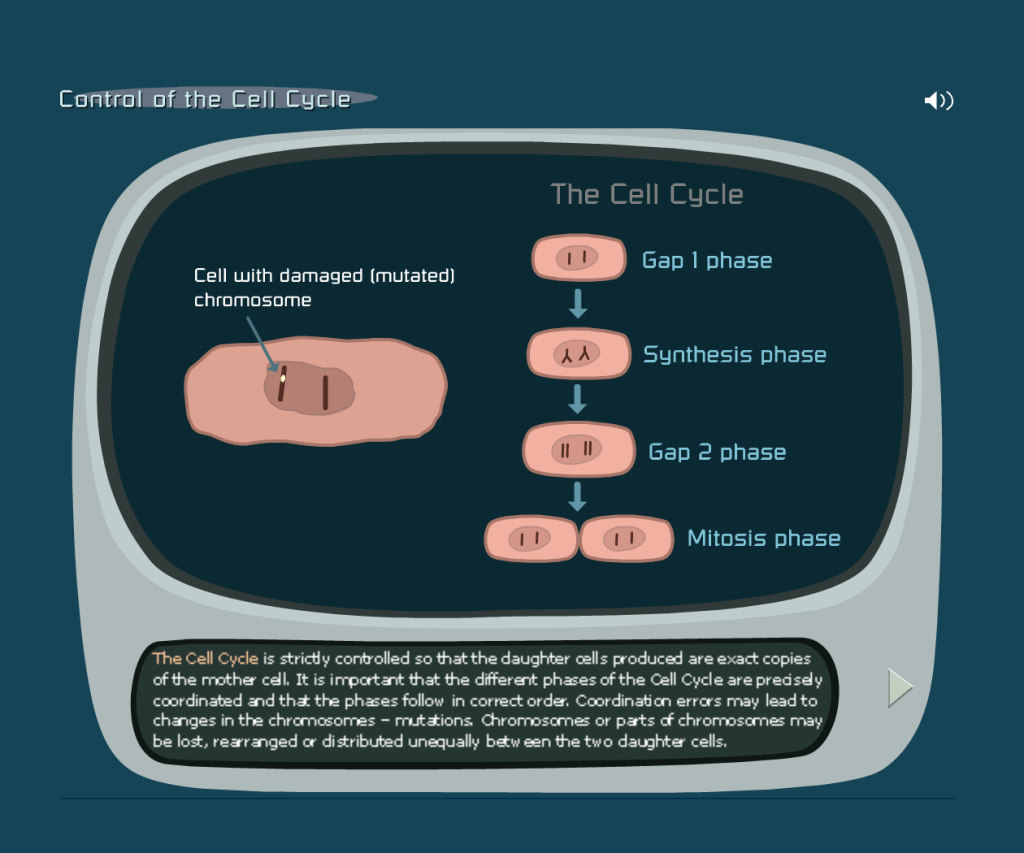
Here, we learn how the cell division occurs step by step showing each phase in order, emphasizing that this is how it should be followed. Hint: this is very important for when the game actually starts!
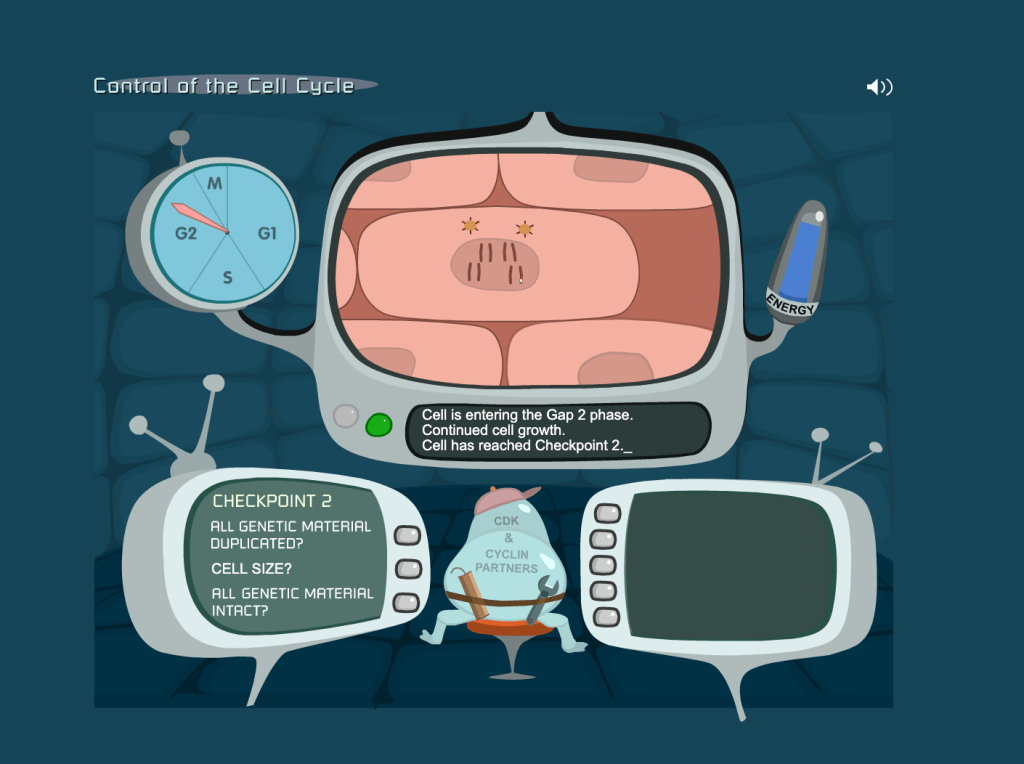
Now, the action! By the time we reach the three screens, we can check off most of Avedon’s list. The role of the player is to be the key molecule working for “CDK or Cyclin partners” (whose role is described on the third picture). The big screen with the meter shows the work being done by the player, measuring the progress of the cell division process being conducted by the CDK or the player.
The screen on the left, keeps you on track through checkpoints, you are asked questions and you answer on the right screen by clicking on the buttons on the right side of the screen. On the big screen (center) there is also an “energy” chemical. When playing the game and making the wrong move this energy chemical is reduced. If it is low, you will be asked to review the phase you selected. An error when doing this will result in the cell dying and the game ending. Choosing the right phase and making the right decisions will lead you to the mitosis phase and a full completion of the cell cycle.
It is important to acknowledge that when using Avedon’s checklist not everything will be in order, nor it will be directly presented to the player. For example, on this particular game, the number of players is not listed, instead it is assumed. That is to say, not everything will be explained to you and be straight forward when on the game.
However, while going around the game you will find out that Avedon’s seven factors are in fact there! I found the purpose of the game; It was clear that it was designed for one player, the procedures and rules governing action, as well as the role of the participant were on the storyline. When presented with the game, the “participant’s interaction pattern” were to click on the buttons. Last but not least the results, which depended on the player’s action, were shown at the end. Losing would have its consequences.The key molecule had done its job wrong so it shows you on the screen that the cell died. You can only win if the energy chemical does not run out, meaning, you had to choose wisely and go in the order of the cycle.
What caught my attention about this game was the way that it was organized. Paying attention to the details, you could see that the designers and creators made sure the game ran smoothly. Overall, I didn’t have any complications. Since the objective of this serious game is to teach its audience the cell cycle and how to achieve mitosis, winning would mean that you have succeeded and achieved this goal (which I did after a few tries). You cannot go through the game without actually knowing the phases and paying attention to the storyline!
References
Current Practices in Serious Game Research. Games-Based Learning Advancements for Multi-Sensory Human Computer Interfaces, 232–250. doi: 10.4018/978-1-60566-360-9.ch014
Stenros, J. (2016). The Game Definition Game: A Review. Games and Culture, 500–520. doi: 10.1177/1555412016655679Nobel Media AB. (2014).
The Control of the Cell Cycle. Retrieved from https://educationalgames.nobelprize.org/educational/medicine/2001/Wouters, P., Spek, E. D. V. D., & Oostendorp, H. V. (2009).
 Critical Play Journal