Identifying a Serious Game: Part 2
Bound by Blood Review
As discussed in my previous journal, the main objective of a serious game is to teach. Serious games are life-skill games, and they are not just for mere entertainment, they teach you a lesson.
Choosing the Game
The game was created by a student for a class assignment at a university. In her description, she mentions that she “can’t promise this game will be fun for you. But I hope it makes you think.” From the jump for some reason, this caught my attention. I thought to myself why would she say this about her own game, now I want to give it a try.
The best word to describe the game “Bound by Blood” is raw. The development of the game is slow in terms of the actions it requires from the player, but its purpose makes the player realize how hard life could be.
What is the game about?
The game is a short narrative. There are no visible characters. The game consisted of the development of the story and the characters, background sounds, and clicking on the decision the player chose (me) portraying the main character, Beth.
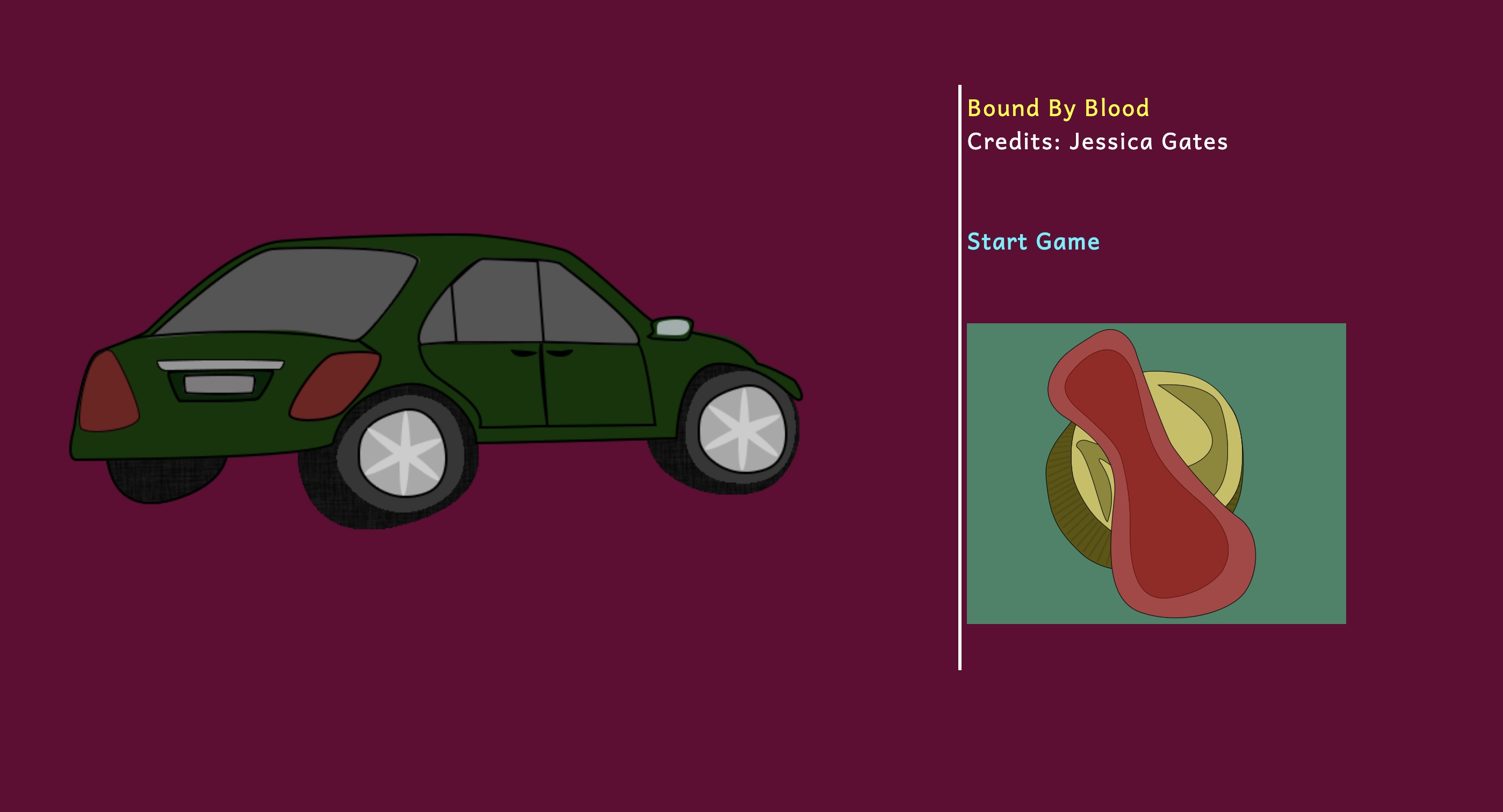
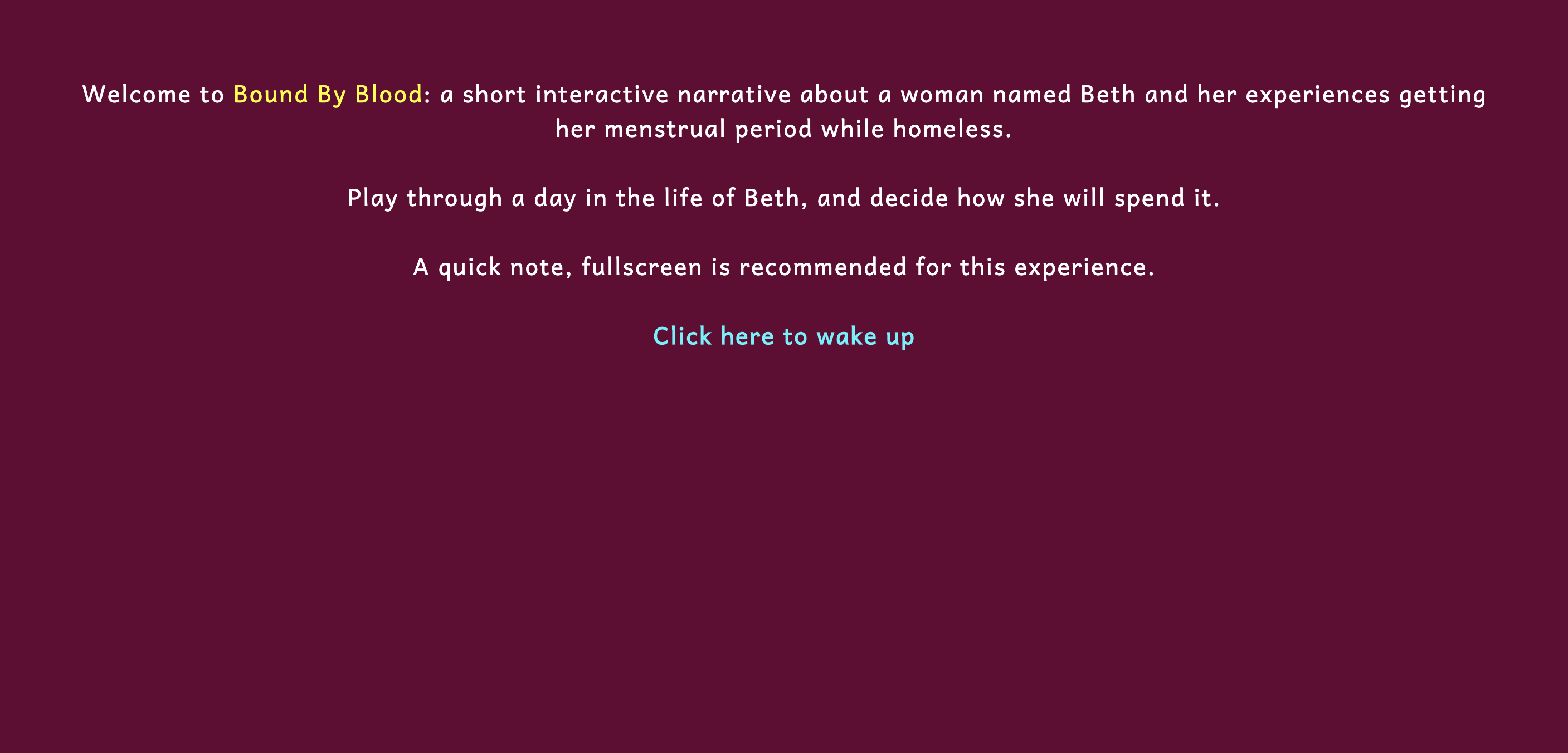
When clicking on the game, I was presented with a screen saying, “Welcome to Bound by Blood.” It continues by briefly introducing the game, stating, “a short interactive narrative about a woman named Beth and her experiences getting her menstrual period while homeless. Play through a day in the life of Beth, and decide how she will spend it.” The game begins when clicking “Click here to wake up.”
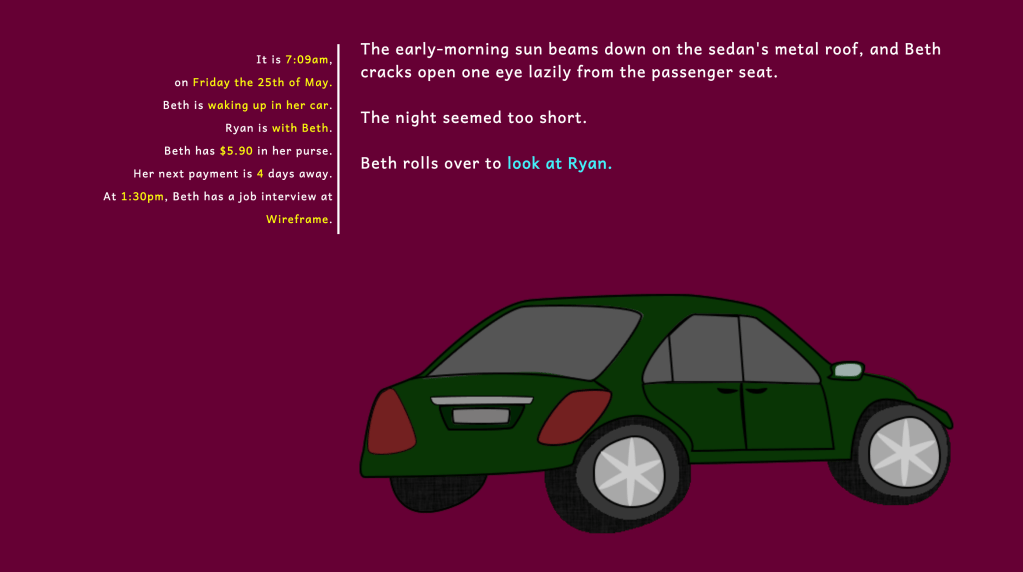
On the left side of the screen, the player is showed the time of the event, and Beth’s current situation. Beth was waking up in her car at 7:09 am (she is homeless) with her son, Ryan, she only has $5.90, her next payment is four days away, and she has a job interview at 1:30 pm. The right side of the screen shows the decisions the player has to make while the story develops. The decisions executed by the player does not start being a problem until Beth starts menstruating, right before her job interview. Later on, depending on the path you have chosen, you could face different situations. Like for example, running to the supermarket, starving, your menstruation getting in the way of your interview, etc.
Going back to Avedon’s checklist, the concept meets the requirements of the list representing the structure of a game because:
- There is a purpose behind the idea; that is to bring awareness to the experiences of women and most importantly homeless people.
- The brief introduction shows the procedures for action of the game.
- There are rules governing action presented when starting the game.
- The number of required players is one.
- The role of the participant is to make decisions.
- The player’s interaction patterns include the player using the mouse of the computer by clicking on their choice while the story develops.
- For the results, you can either win or lose in this game. There is always feedback after finishing the game.
Thoughts on the game itself…
Serious games can develop many different skills that people can use in today’s society. Karen Schrier discusses 21st-century skills regarding augmented reality games, providing a chart as shown below.

The chart was accessed by Schrier through a “framework developed by The Partnership for 21st-Century Skills, an advocacy organization that promotes the education and assessment of 21st century skills,” to specifically address the benefits of playing augmented reality games. However, the same could be used to bring knowledge to skills that could be gained through experiencing serious games.
After analyzing the chart, some of the skills that stood out for me when playing Bound by Blood were social and community awareness, critical thinking, creativity and curiosity, and consideration of multiple perspectives. As stated by the creator of Bound by Blood, the primary purpose of the game is to bring awareness to a social issue that does not get much attention on the media. The game not only brings awareness to the problem, but it requires you to put yourself in a situation where you have to evaluate and decide how to address such an issue. To approach the issue, you have to be creative, but you also have to think critically, because you are representing the life of someone. Taking into consideration Beth’s socio-economic conditions –and how she lives with her son in her car–you are forced to experience life from different perspectives. Like for example, Beth’s son plays a huge role in this game, and so the player is continuously thinking about “What would her son think if I choose to do this? How does he feel about the whole situation? How is he dealing with this?”
When identifying a serious game it is important to have these skills in mind as they could be a helpful tool to consider whether the game is serious or not!
Conclusion
Starting the game, I was already skeptical because of the student’s introduction. The student also mentioned that “it was about an issue that… needs more conversation in today’s world”. I was surprised when I started the game and realized it was about PERIODS. Regardless of the student’s introduction, the concept of the game was to teach its audience about the life-decision people living in poor-conditions have to make on a daily basis, and this is what a serious game is supposed to do.
Nonetheless, after I finished playing the game and failed, I was very eager to try it again. I felt like I could relate to Beth as a woman, and I was very curious about her situation. Moreover the fact that I had failed, and did not help her, made me want to go back and see what I could do for her differently. Preferably I would have liked to see more images, but it is a low-budget game. Despite its quality, the game leaves a significant impact on its audience, encouraging them to improve and use a handful of skills bringing awareness to the struggles of many women and homelessness.
References
Schrier, Karen. “Using Augmented Reality Games to Teach 21st Century Skills.” ACM SIGGRAPH 2006 Educators Program on – SIGGRAPH 06, 2006, doi:10.1145/1179295.1179311.
 Critical Play Journal