Featured

Entry #1

Defining [Serious] Games

What is a Game?

First things first….

Surprisingly, there is not an exact definition for the word game. In fact, to get an idea of how inconvenient this is, there are over 50 definitions that claim to define the word “game.” Within all the definitions and the ones that continue to be added to the realm there is something that stands out about them; this is that some factors are recognized to be common within all game definitions. Because of the idea of sharing common grounds, to me, what defines a game is the nature of the given concept and its characteristics.

The article, “The Game Definition Game: A Review “by Jaakko Stenros shares many game definitions while analyzing them. Among those definitions, there is a list of seven elements that were initially introduced by Elliott Avedon in 1971. According to the list, for something to be regarded as a game it must have (1) a purpose, (2) as well as include procedures for action and (3) rules governing action. Additionally, a game must have a (4) number of required players (one or more active participants), (5) the roles of the participant, (6) participant interaction patterns, and (7) results (Stenros, 2016).
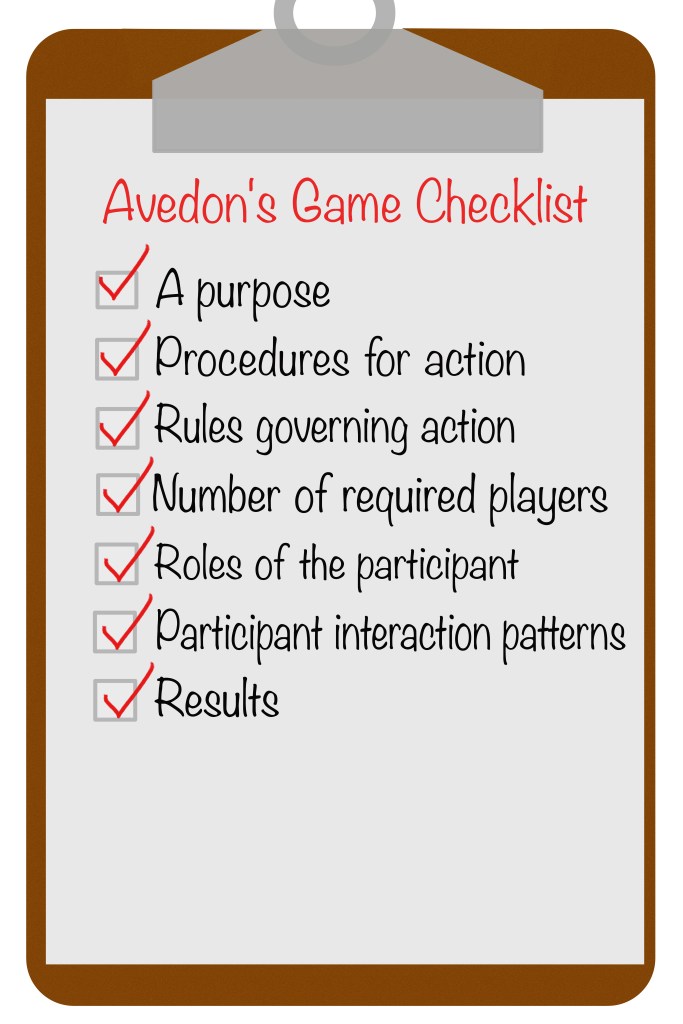
Based on the games that I have played in my lifetime, I would consider the list a perfect description of what a game consists of. I am aware that it is not formatted like an actual definition. However, since there is not an exact definition for the word “game”,this could be used as a checklist when debating whether a concept should be regarded as one.

The idea of using a checklist instead of an exact definition gives us the freedom to choose not only what qualifies as a game but it also helps when categorizing games. There are many different types of games varying on themes, objectives, platforms, genre, etc. Later on, we will see how the checklist could be used to identify and categorize a specific type of game.

Serious Game Definition

The definition of a serious game draws out the elements of a game provided above. For a game to be serious, you would have to add the components that make it serious. Right? In addition to the elements stated by Avedon, there are specific factors that, in combination, contribute to the definition of serious games.

Now, when I first heard of serious games, it was recently, when I had signed up for the class. The first thing that came to my mind was, “How can a game be possibly ‘serious’? A game is a game. It is meant to be playful and fun. ” I am sure I am not the only that has that reaction when hearing the word serious as an adjective to the noun “game”, for sure. However, I have come to learn that the word serious is not meant to take away the “fun” part that we expect from games.  On the contrary, it proves a game can be utilized for more than just mere entertainment.

I have concluded that what makes a serious game, “serious,” is its design and well-crafted goal to teach. That is, a serious game is a well-rounded game meant to teach a player a specific lesson, depending on its theme. Serious games are designed to help improve performance in real-life situations resulting from the completion of a specific objective. 

For instance, these games are applied in different fields, such as management, education, military, and sales. Serious games are life-skills games. Serious games are designed to demonstrate the progress of a player(s) in different areas that are expected to result the following learning outcomes: cognitive, motor skills, affective, and or communicative (Wouters, Spek, & Oostendorp, 2009). 

Identifying a Serious Game

The Control of the Cell Cycle

The “Control of the Cell Cycle” game is found on “The Nobel Prize” and it is described per the website below:

The game is about the different phases in ordinary cell division, mitosis. Between each phase there several “check points” to make sure that nothing happened to the genetic on the way.

In this page you can choose to either be redirected to a more detailed and in-depth description of the game, to start the game, “help” regarding how to play the game, or information about the Nobel Prize. I chose to start the game right away. 

Based on my definition of a serious game in combination of the characteristics that make up a game, I was able to recognize “The Control of the Cell” as a serious game. This is how!
Revisiting Avedon’s Checklist, I first identified the purpose of the game. From the title and the description we can tell that the game is about mitosis and we will be learning about the cell cycle.
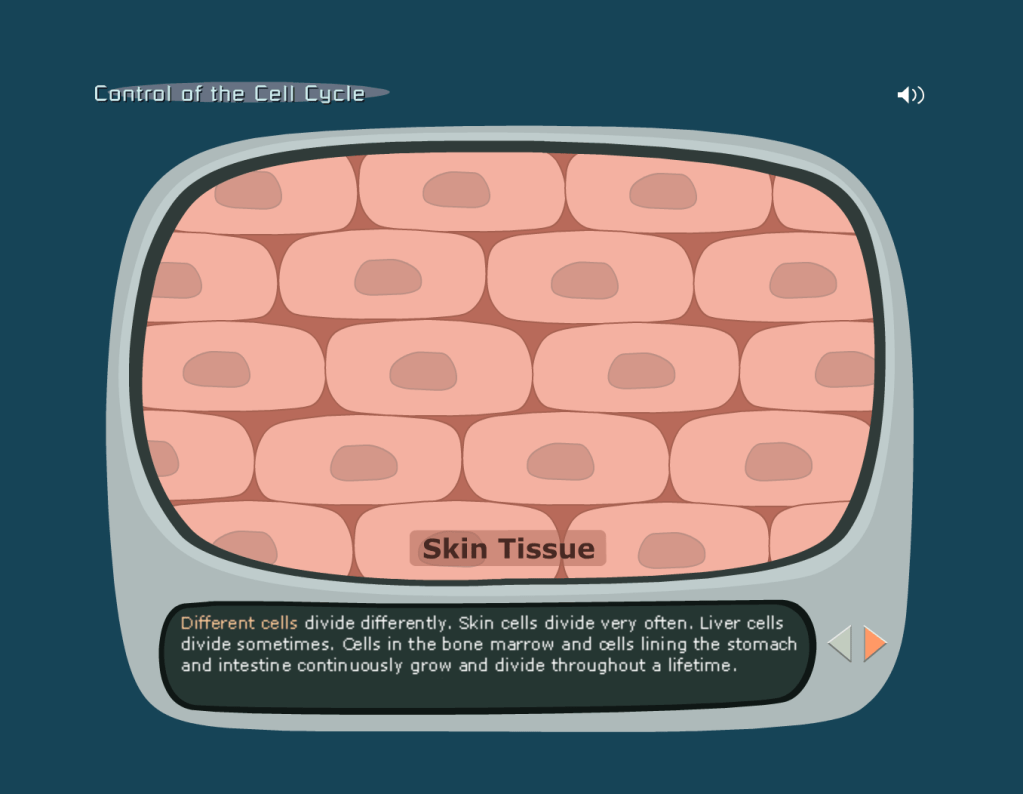
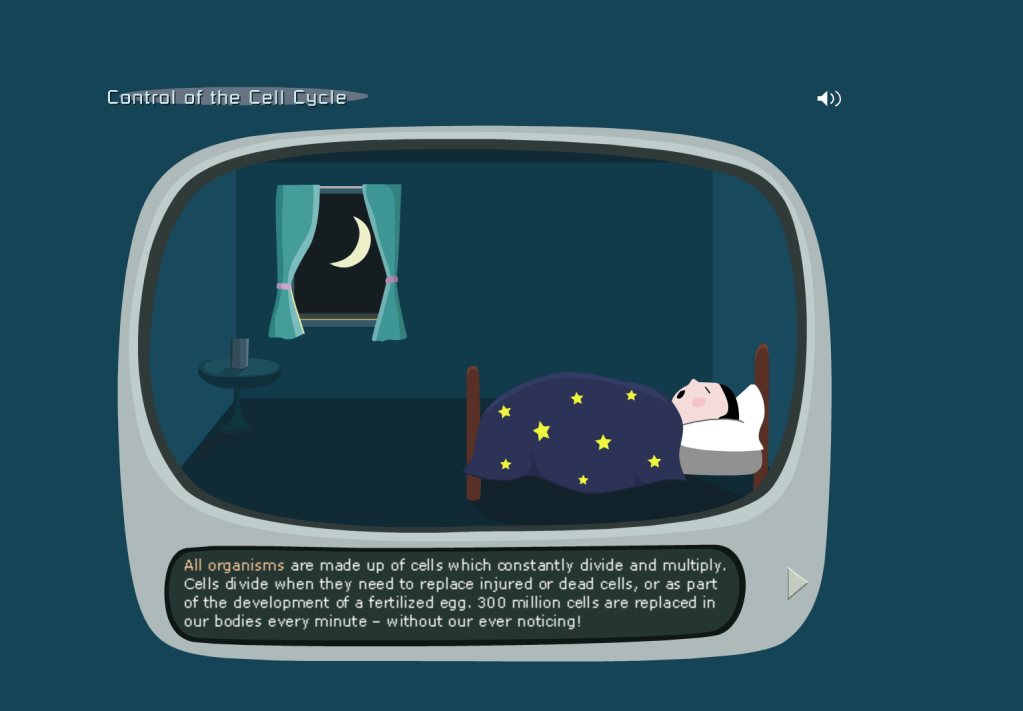
The storyline starts up with a boy laying down in bed and continues developing by explaining that we have different cells in our bodies.
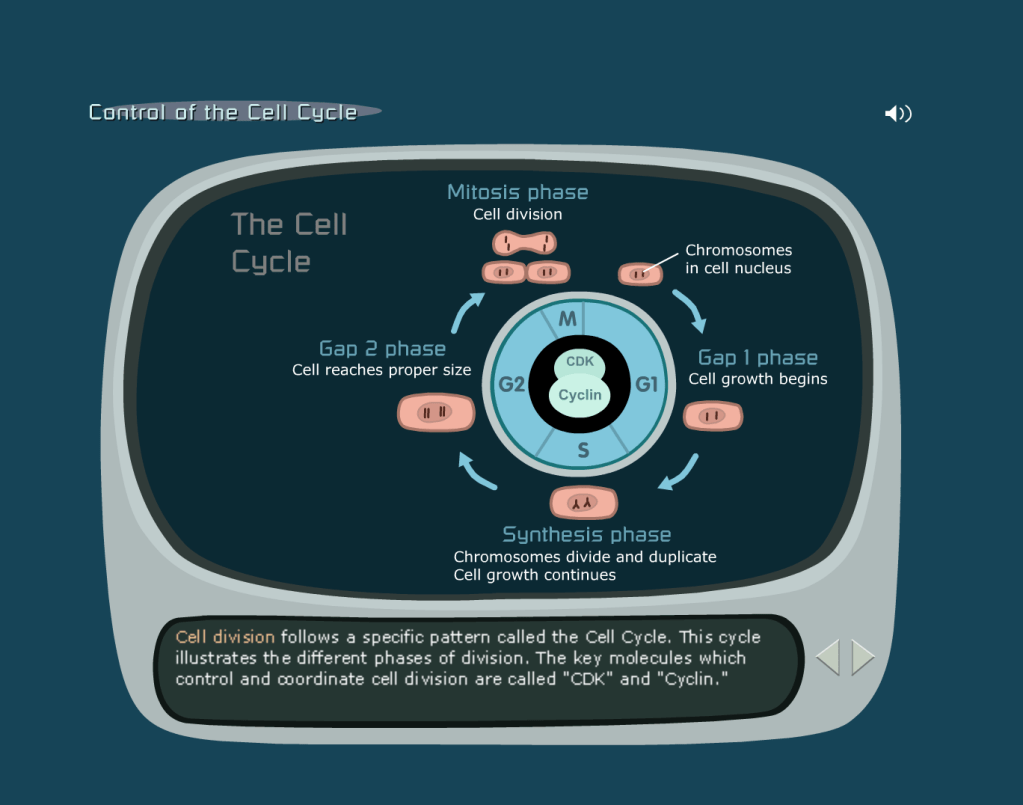
Through the storyline, we get to learn about the cell cycle and what each phase represents. We are also introduced with new terms as we go along.
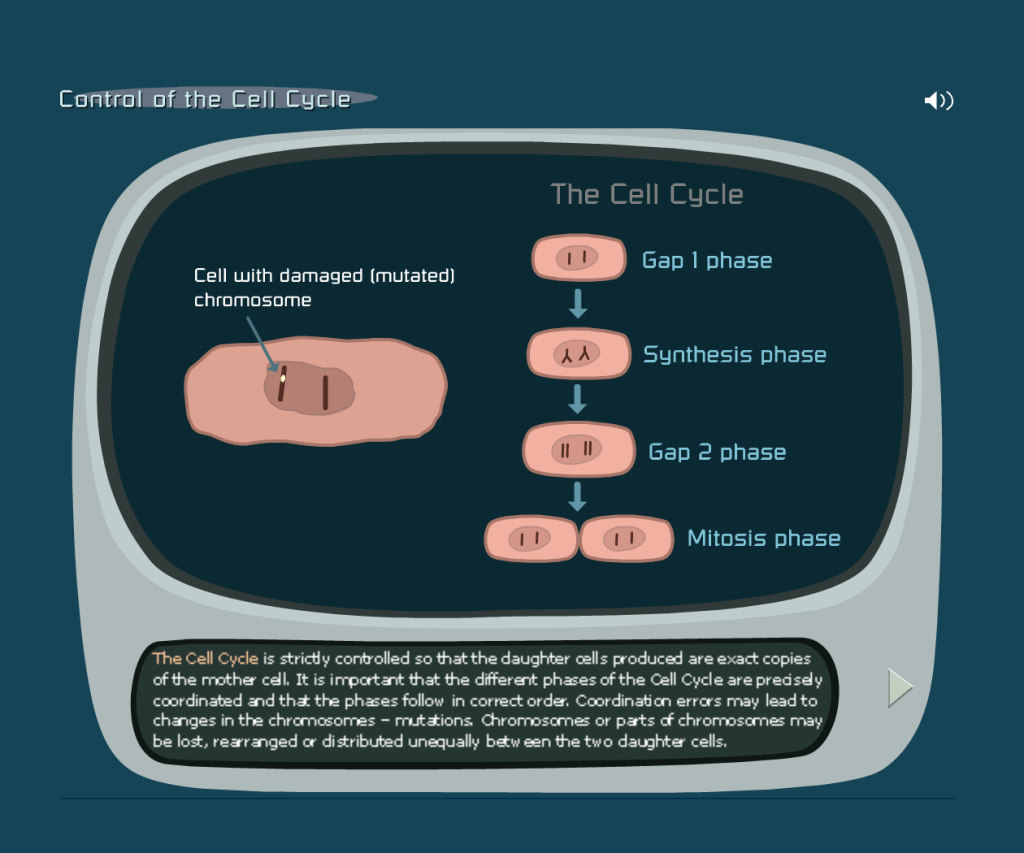
Here, we learn how the cell division occurs step by step showing each phase in order, emphasizing that this is how it should be followed. Hint: this is very important for when the game actually starts!
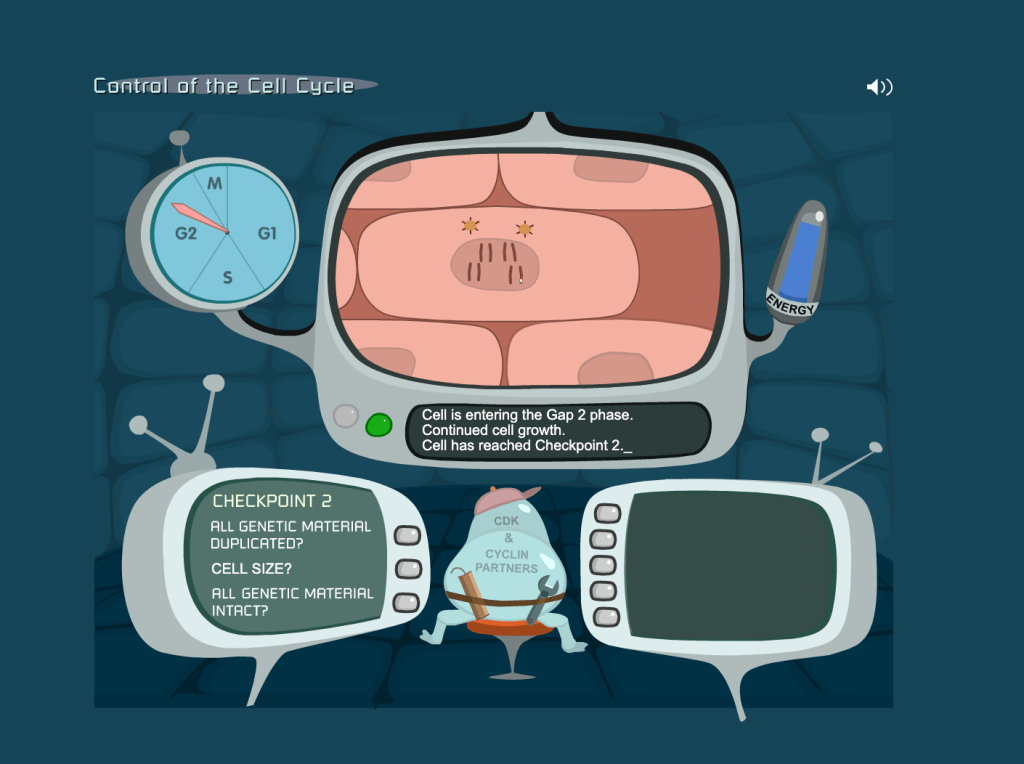
Now, the action! By the time we reach the three screens, we can check off most of Avedon’s list. The role of the player is to be the key molecule working for “CDK or Cyclin partners” (whose role is described on the third picture). The big screen with the meter shows the work being done by the player, measuring the progress of the cell division process being conducted by the CDK or the player.

The screen on the left, keeps you on track through checkpoints, you are asked questions and you answer on the right screen by clicking on the buttons on the right side of the screen. On the big screen (center) there is also an “energy” chemical. When playing the game and making the wrong move this energy chemical is reduced. If it is low, you will be asked to review the phase you selected. An error when doing this will result in the cell dying and the game ending. Choosing the right phase and making the right decisions will lead you to the mitosis phase and a full completion of the cell cycle.

It is important to acknowledge that when using Avedon’s checklist not everything will be in order, nor it will be directly presented to the player. For example, on this particular game, the number of players is not listed, instead it is assumed. That is to say, not everything will be explained to you and be straight forward when on the game.

However, while going around the game you will find out that Avedon’s seven factors are in fact there! I found the purpose of the game; It was clear that it was designed for one player, the procedures and rules governing action, as well as the role of the participant were on the storyline. When presented with the game, the “participant’s interaction pattern” were to click on the buttons. Last but not least the results, which depended on the player’s action, were shown at the end. Losing would have its consequences.The key molecule had done its job wrong so it shows you on the screen that the cell died. You can only win if the energy chemical does not run out, meaning, you had to choose wisely and go in the order of the cycle.

What caught my attention about this game was the way that it was organized. Paying attention to the details, you could see that the designers and creators made sure the game ran smoothly. Overall, I didn’t have any complications. Since the objective of this serious game is to teach its audience the cell cycle and how to achieve mitosis, winning would mean that you have succeeded and achieved this goal (which I did after a few tries). You cannot go through the game without actually knowing the phases and paying attention to the storyline!


References

Current Practices in Serious Game Research. Games-Based Learning Advancements for Multi-Sensory Human Computer Interfaces, 232–250. doi: 10.4018/978-1-60566-360-9.ch014

Stenros, J. (2016). The Game Definition Game: A Review. Games and Culture, 500–520. doi: 10.1177/1555412016655679Nobel Media AB. (2014).

The Control of the Cell Cycle. Retrieved from https://educationalgames.nobelprize.org/educational/medicine/2001/Wouters, P., Spek, E. D. V. D., & Oostendorp, H. V. (2009).
Entry #5

Scratch as a Serious Game

Scratch

Based on Raph Koster‘s instructions for a concrete and helpful game analysis, it is crucial to dissociate one’s experience with the game; only then can one generate a specific analysis of the game itself while avoiding biases. His purpose for creating the article “How I analyze a game” is to look at games from a mechanical perspective, as he uses its criticism to improve his own craft. To put in theory Raph Koster’s critical questions, I will set aside my experience to answer these and analyze Scratch. 

What are the systems?

Scratch is a free platform for anyone to create games or stories with the programming language developed by the MIT Media Lab. Blocks represent a specific code. Depending on how the player arranges the blocks, as they are attached, a code line is created. There are many several ways to use the blocks as you can develop different functions for your sprites to take action. Background coding experience could be useful; however, the game is set so that the player could learn the system by exploring out of curiosity. There is not a specific way of how to play. You establish your own measures for what you want to get out of it. 

What are the systems about? 

The projects created in Scratch could be about anything. It is a place where you can explore your creativity. As the player, you set your limit. However, it is meant to teach the players how to code. Through coding, the players critically engage with the program to achieve actions from their sprite. In this case, the player creates and solves the problems.

How do I touch the system, and how does it touch me?

To give you an insight on how to use the platform, Scratch offers tutorials found on the menu bar (with a lightbulb symbol next to it). Mainly, this would be great for beginners on Scratch. There are a variety of tutorials ranging from how to get started to how to code an animation. The platform interacts with the player by asking the player if they would like to start with a tutorial. After the message is displayed, with the tutorial, you are open to creating anything.  

What is the game experience?

There are three options for you to choose from the toolbar, code, costumes, and sounds. The costume selection allows you to add sprites and modify them. In sound, you can add background music, add sounds to the sprite(s), and add sounds to different actions and backgrounds. In the code section, you can find different color blocks. Each color represents actions to be applied to the animation: motion, looks, sounds, events, control, sensing, operators, variables, and a section designated for blocks the player might want to create. Scratch also allows you to test your code line(s) as well as share and publish your final result to receive feedback from others. 

What is the experience about?

In comparison to other programs like Code Academy, the designers of Scratch were specifically targeting a younger audience. From the home page of the Scratch website to the page where players create, it is clear that the design formulated was to influence kids. The colors of the website are fun, and bright colors, the main sprite (Scratch) is an animated cat. The coding language taught by Scratch is unique and original, chiefly because this language is nothing like Java, C++, or Python. That is to say, the language in Scratch is not designed to program or communicate with an actual machine or computer. 

Do these things all match up? 

Overall, the program incorporates 21st-century skills into a versatile game for a younger audience. The integration of collaboration, critical thinking, creativity, and technology can potentially have a great impact on kids. These skills can be used in the workforce as well as in other real-life situations. A serious game like Scratch, prepares kids for the future.

What about fun?

For the audience that is intended for (8+), Scratch is considered fun.

Class Interaction with Scratch 

Interacting with Scratch in class brought back many memories and not good ones. I want to start by saying that I do not have anything against the Scratch platform or what it is intended to do. Yes, I think this platform could be of great use for kids who like creating new things and who might want to get an idea of how frustrating it is to code. Scratch is a platform designed to teach kids how to code through their sole coding language. From my own experience, I did have fun creating games, animations, and playing other creators’ games. People can get incredibly creative here! However, I do not think that Scratch should be used in a college class that claims to be the “introduction to computer and their applications,” as it is used at Rutgers. Oddly, this class is prior to CS111, the computer science introductory class, which dives right into Java. Besides the concept of “a coding language,” how can Scratch compare to Java?

I played two to three games with one of my peers, and we both agreed on them being a little confusing, or not finished by the designers. The hands-on resources from the class were not as exciting as the website itself. For the purpose of the course, I would have rather spent time experimenting with Scratch and creating something directly on the website to get some experience in designing a game. 

To conclude, I believe that Raph Koster’s article on how he analyzes a game helped me change my mind about Scratch. Exploring the game using Koster’s theory made me realize the potential Scratch holds as a serious game that incorporates 21st-century skills for kids’ learning and development. Without dissociating myself from the game, I would not have been able to answer correctly the questions Koster uses. I have also gained a better understanding of the purpose of the game (outside of the CS110 class). 

Entry #3

Educational Games by National Geographic

Krill Smackdown

  • What’s the game goal? Is it clear? Is it compelling to me? Why or why not? 

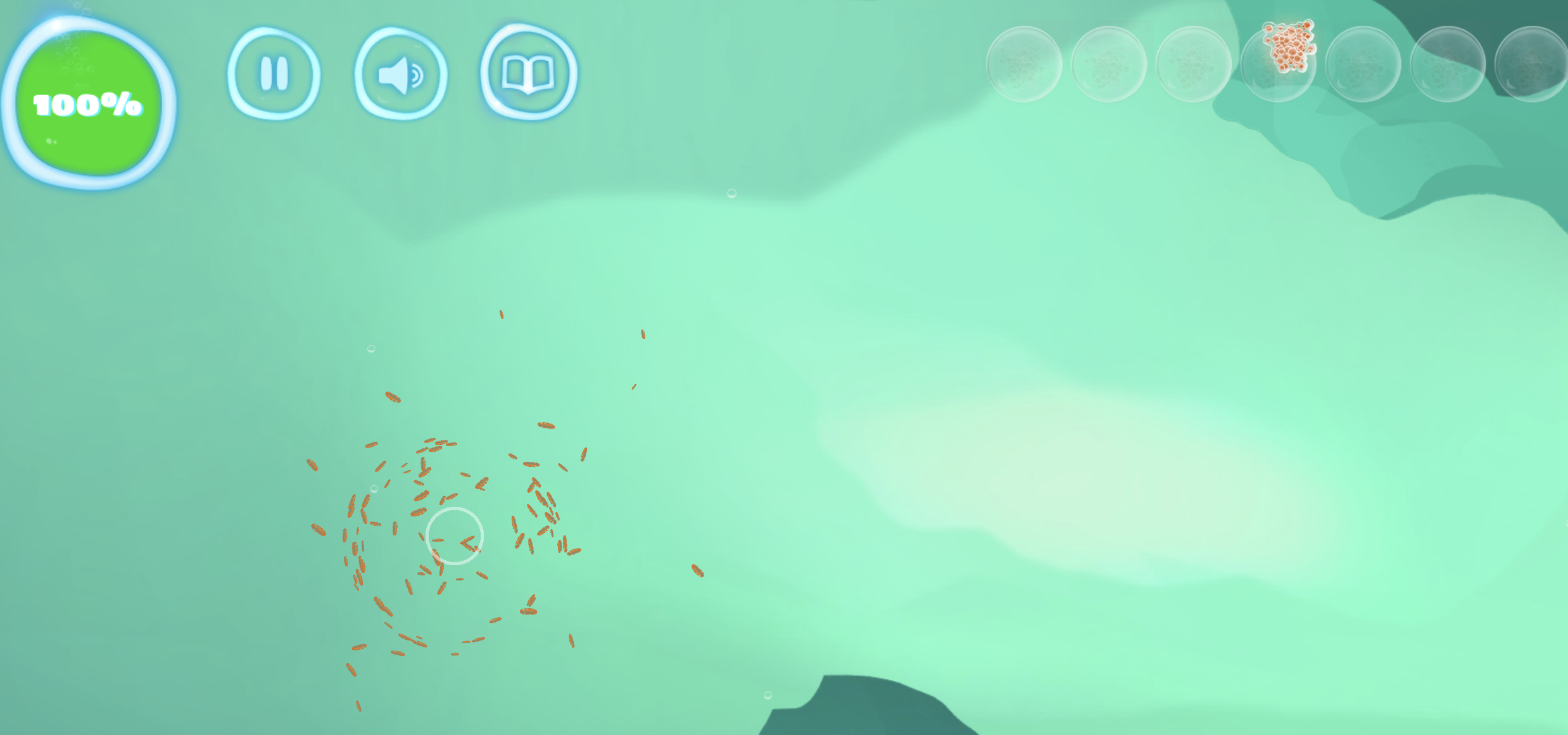
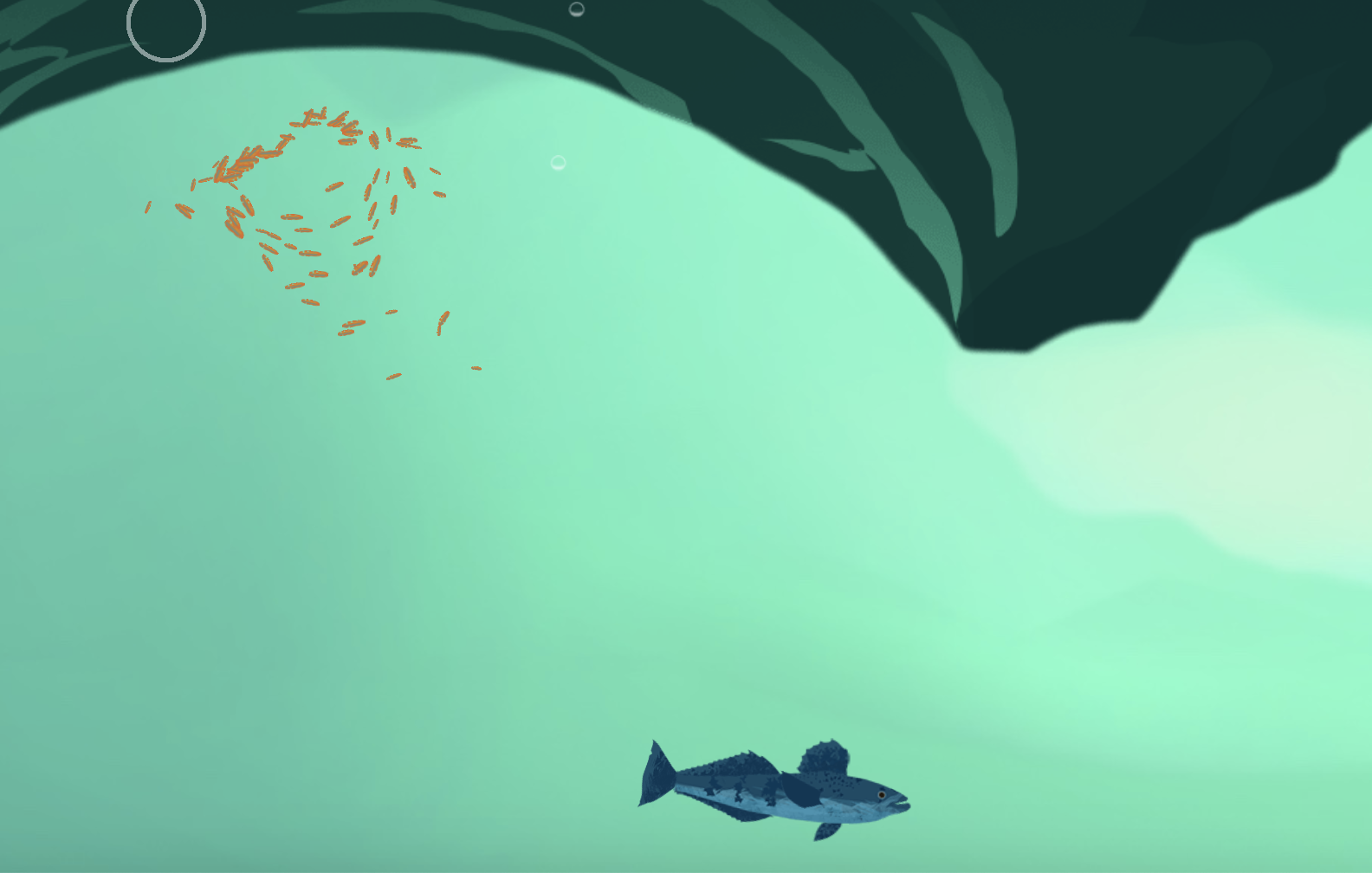
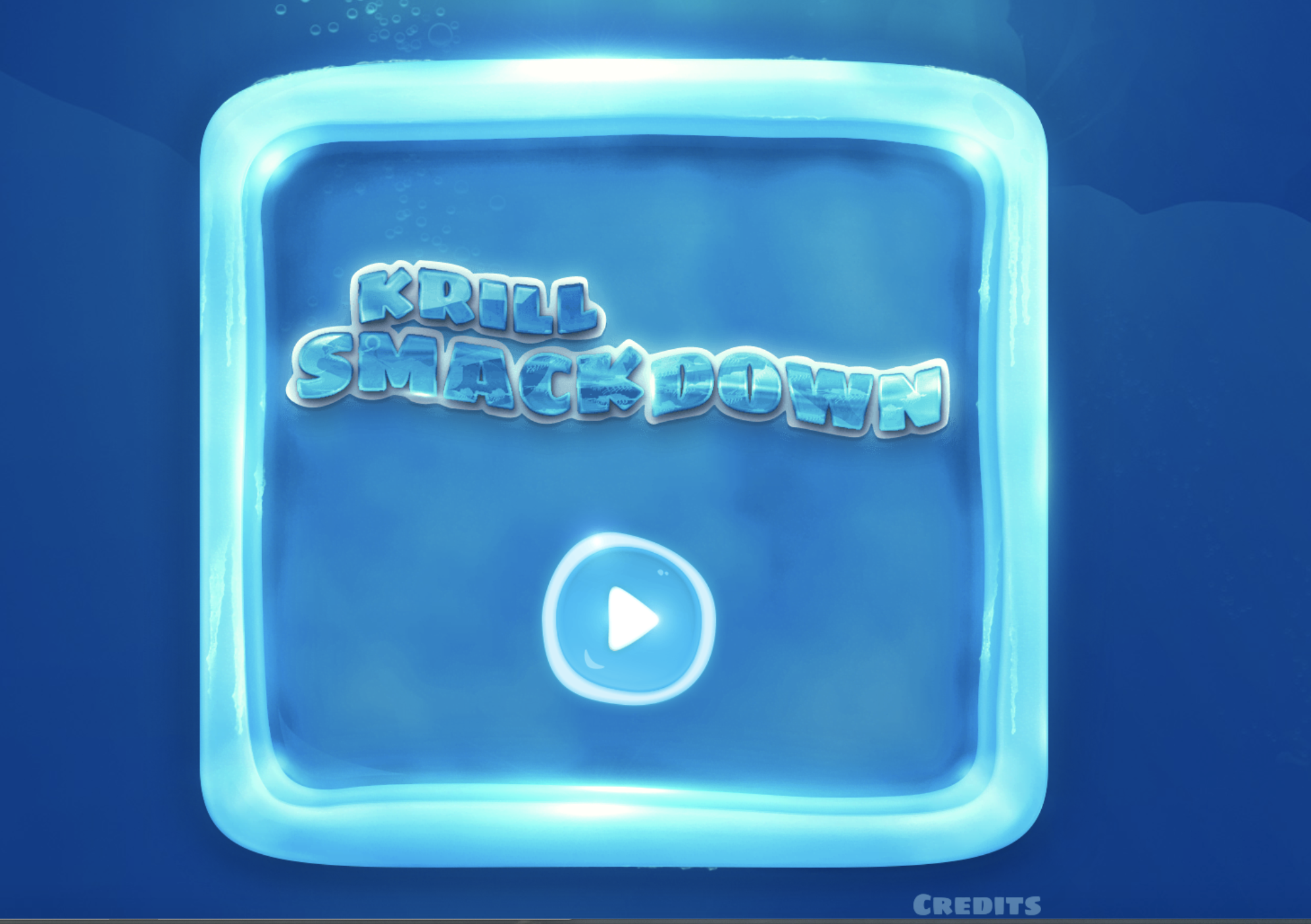
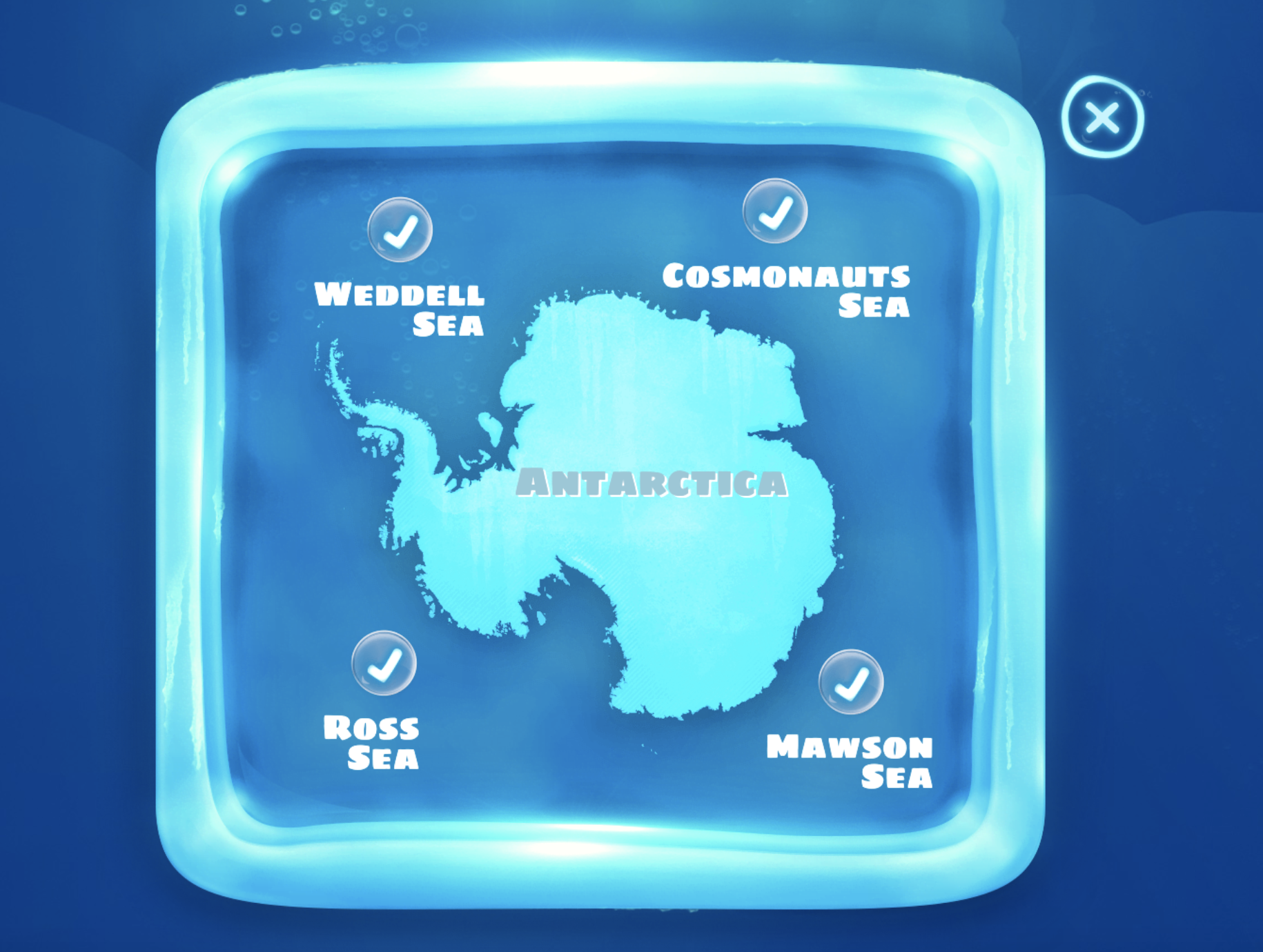
The game I chose for this third journal entry was Krill Smackdown. The goal of the game is to move krill “around the waters off Antarctica” while avoiding predators and collecting all the eggs to expand the group and move to the next level. I was very entertained while playing the game, so for me it was fun to play. However, it is clearly designed for kids, maybe around the age of 6-12.  

  • What’s the game’s core dynamic? Is it exploration, collection, “race to the finish,” solve—or a blend of two different dynamics such as collection AND race to the finish? 

The dynamics include to collect the eggs and avoid the predators.

  • Are the rules clear? How do I learn them? 

The rules are clear. Before starting the game, they are presented to the player as instructions. The instructions also explain the relationship of the krill to how the ocean ecosystem works in regards to the food chain, which I thought was pretty cool. 

  • What game mechanics (aka rules) make the game most fun? Which one(s) would I change? What would happen if I did? 

The double clicking to make the krill’s swim faster makes the game fun. I wouldn’t change the rules.

  •  Do the aesthetics of the game draw me in? What emotional reaction do the aesthetics elicit in me? 

This game reminded of me games I would play when I was in middle school. The functions, were to use the mouse to move the swarm, speeding up the swarm by double clicking, click and hold to separate the swarm. Those things give the player a little rush, specially, when the predators get close, and you can sense a level of difficulty and act fast. 

  •  Is the game “balanced” in the sense that it accommodates different player levels? How? 

I would say that the game it’s balanced just because it starts you off with one predator, and as you pass the level you are faced with more predators. There are different seas, you move to a different one when passing a level. But overall, it is designed for a specific audience, kids less than 12 years of age I would say.

  • What’s the balance between strategy and chance? Do I feel like I have control over the outcome by the choices I make in the game or do I feel the outcome is almost all chance? 

In this aspect I feel like you do have a high chance of winning, but you also need to be strategic about it, especially when moving up to different levels.

  •  Is the game cooperative, competitive, or a blend of both? 

You do not need another played nor it is allowed. It could be competitive because you want to reach other levels, and it feels like you are “beating” the predators. In a sense, you are competing with the predators that are controlled by the computer.

  •  If the game is competitive and I lose, how does this make me feel? Does it motivate me to play again or do I want to avoid playing again so I can avoid losing? 

The level of difficulty does motivate me to play. When winning it feels like you are beating the predators and it definitely encourages you to stay playing the game. Even if you lose, you want to keep playing. Some of the things that motivated me to play again were the changes of scenery–the water changes its color from blue to green–and in some cases, you can go deeper in the ocean.

  • If it’s a digital game, how easy is it to navigate? Can I quickly learn by exploring? 

The game is digital, and it is extremely easy to navigate, this is one of the reasons of why I chose it as my “favorite.” The game was designed for kids and just by reading and exploring anyone could get the hang of it. 

  •   Finally, as a learning game designer, what elements from this game could I use in a game I design? 

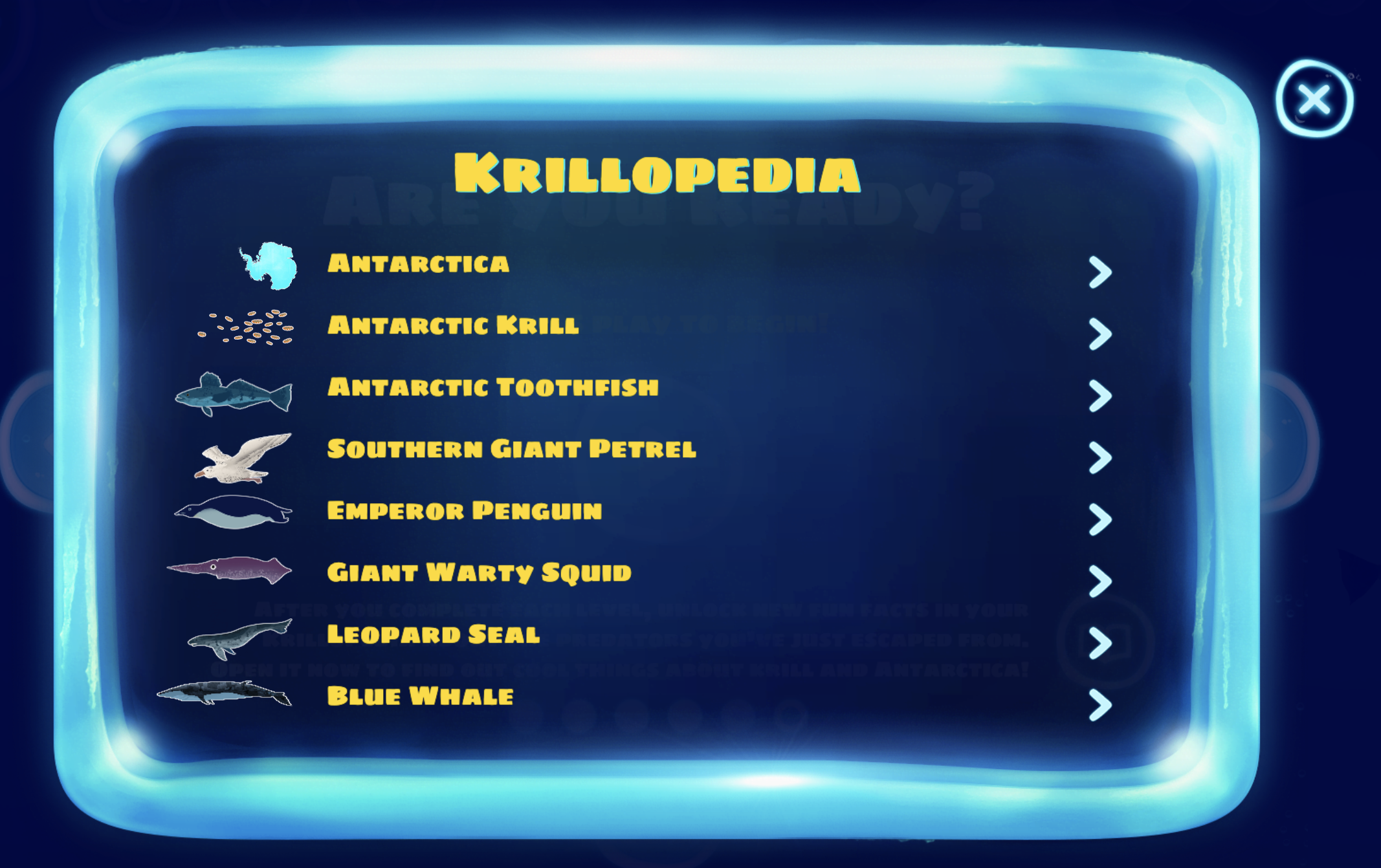
How easy it is to manage and its level of entertainment as well as difficulty, make me believe that the designers were very focused on its audience and always thought, “what would our audience like?”. I liked how the instructions were shown to the player instead of offering a “help” button, everything was given to you. I would also consider incorporating different sceneries because I think that aesthetics improves an audience’s level of commitment to a game. You don’t want to play something that is bland and always looks the same. Something that I didn’t like about the game was how the “Krillopedia” was hidden. This was an option that would come up when you would move on to a new level. It would offer you to read a about the new predators you encounter. I personally did not think I was encouraged enough to click on it, I think that kids wouldn’t either. You could easily avoid the Krillopedia, not learn about the predators and just continue to the next level.  Instead of having the Krillopedia hidden, I would present the information to the kids first when moving to a new level and then save it on the Krillopedia for them to go back to. 

Entry #2

Identifying a Serious Game: Part 2

Bound by Blood Review

As discussed in my previous journal, the main objective of a serious game is to teach. Serious games are life-skill games, and they are not just for mere entertainment, they teach you a lesson.

Choosing the Game

The game was created by a student for a class assignment at a university. In her description, she mentions that she “can’t promise this game will be fun for you. But I hope it makes you think.” From the jump for some reason, this caught my attention. I thought to myself why would she say this about her own game, now I want to give it a try.

The best word to describe the game “Bound by Blood” is raw. The development of the game is slow in terms of the actions it requires from the player, but its purpose makes the player realize how hard life could be.

What is the game about?

The game is a short narrative. There are no visible characters. The game consisted of the development of the story and the characters, background sounds, and clicking on the decision the player chose (me) portraying the main character, Beth.

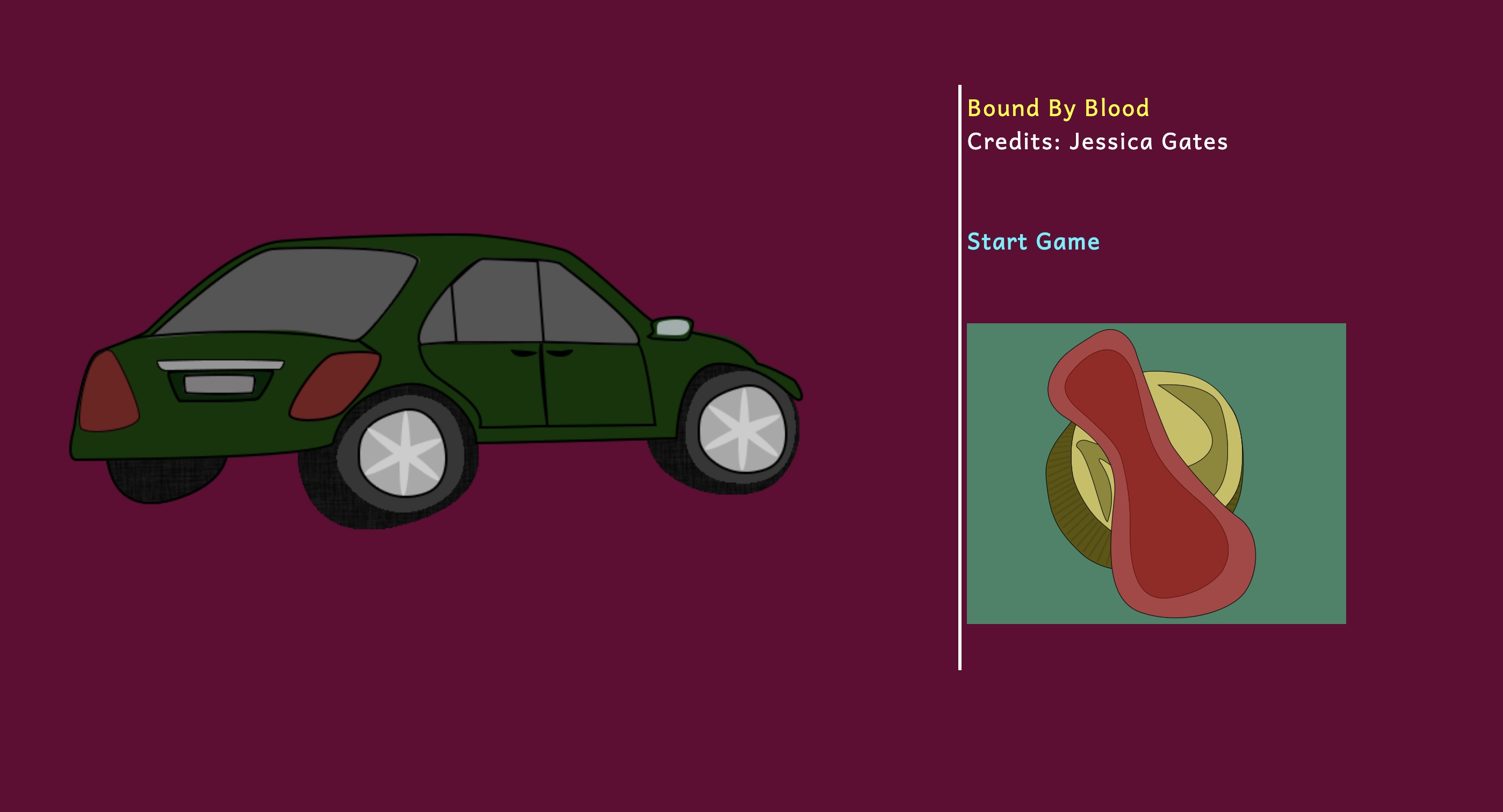
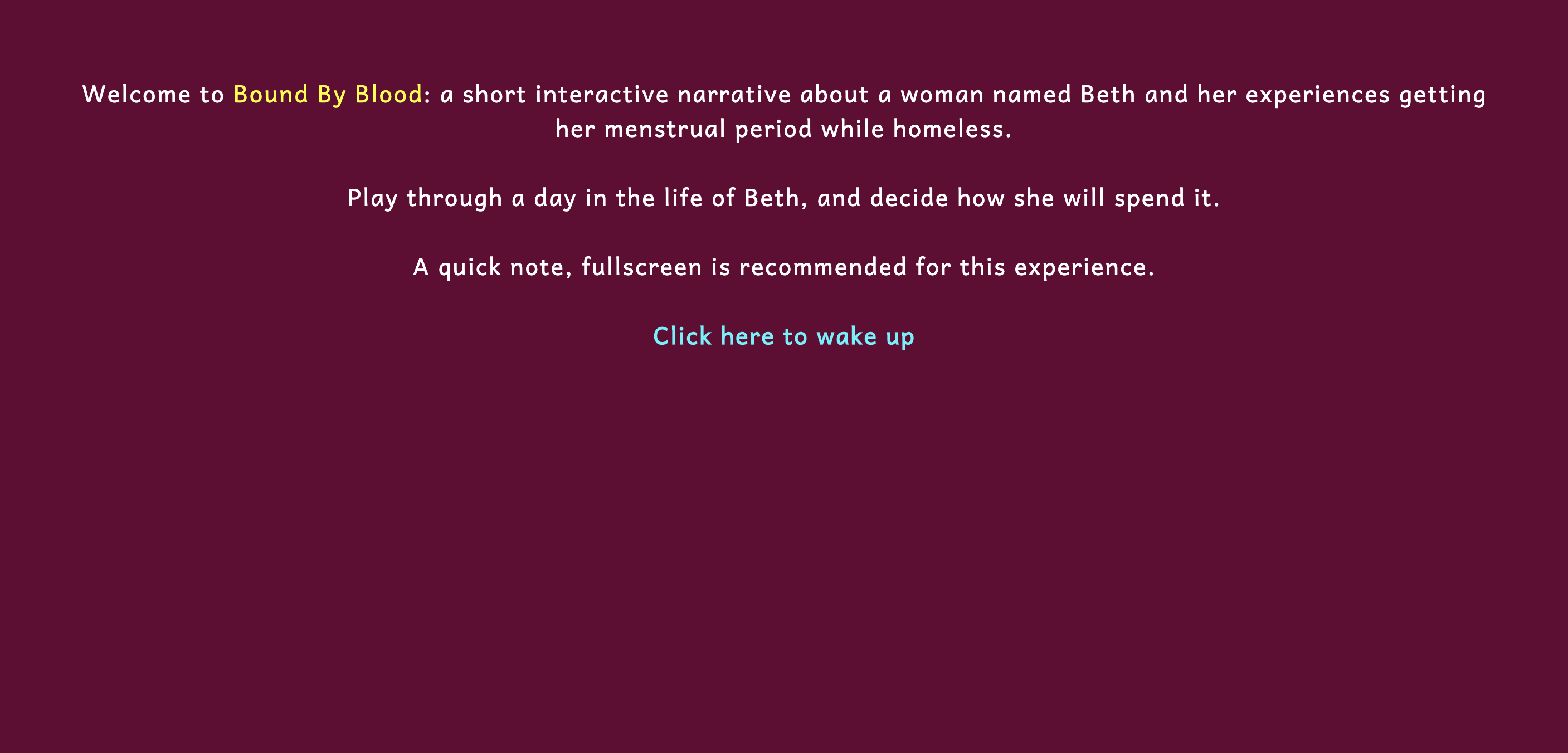
When clicking on the game, I was presented with a screen saying, “Welcome to Bound by Blood.” It continues by briefly introducing the game, stating, “a short interactive narrative about a woman named Beth and her experiences getting her menstrual period while homeless. Play through a day in the life of Beth, and decide how she will spend it.” The game begins when clicking “Click here to wake up.”

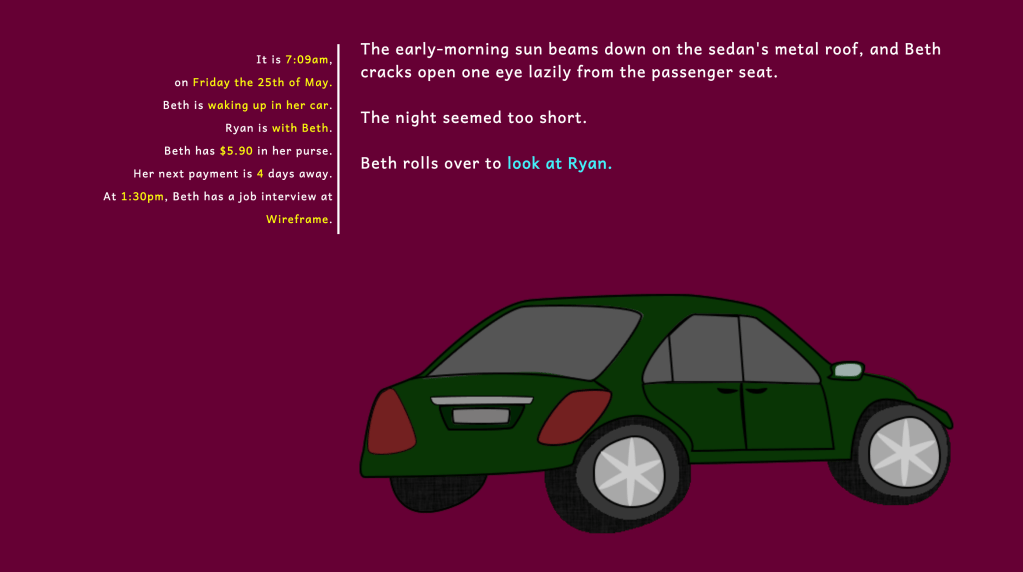
On the left side of the screen, the player is showed the time of the event, and Beth’s current situation. Beth was waking up in her car at 7:09 am (she is homeless) with her son, Ryan, she only has $5.90, her next payment is four days away, and she has a job interview at 1:30 pm. The right side of the screen shows the decisions the player has to make while the story develops. The decisions executed by the player does not start being a problem until Beth starts menstruating, right before her job interview. Later on, depending on the path you have chosen, you could face different situations. Like for example, running to the supermarket, starving, your menstruation getting in the way of your interview, etc.

Going back to Avedon’s checklist, the concept meets the requirements of the list representing the structure of a game because:

  1. There is a purpose behind the idea; that is to bring awareness to the experiences of women and most importantly homeless people.
  2. The brief introduction shows the procedures for action of the game.
  3. There are rules governing action presented when starting the game.
  4. The number of required players is one.
  5. The role of the participant is to make decisions.
  6. The player’s interaction patterns include the player using the mouse of the computer by clicking on their choice while the story develops.
  7. For the results, you can either win or lose in this game. There is always feedback after finishing the game.

Thoughts on the game itself…

Serious games can develop many different skills that people can use in today’s society. Karen Schrier discusses 21st-century skills regarding augmented reality games, providing a chart as shown below.

The chart was accessed by Schrier through a “framework developed by The Partnership for 21st-Century Skills, an advocacy organization that promotes the education and assessment of 21st century skills,” to specifically address the benefits of playing augmented reality games. However, the same could be used to bring knowledge to skills that could be gained through experiencing serious games.

After analyzing the chart, some of the skills that stood out for me when playing Bound by Blood were social and community awareness, critical thinking, creativity and curiosity, and consideration of multiple perspectives. As stated by the creator of Bound by Blood, the primary purpose of the game is to bring awareness to a social issue that does not get much attention on the media. The game not only brings awareness to the problem, but it requires you to put yourself in a situation where you have to evaluate and decide how to address such an issue. To approach the issue, you have to be creative, but you also have to think critically, because you are representing the life of someone. Taking into consideration Beth’s socio-economic conditions –and how she lives with her son in her car–you are forced to experience life from different perspectives. Like for example, Beth’s son plays a huge role in this game, and so the player is continuously thinking about “What would her son think if I choose to do this? How does he feel about the whole situation? How is he dealing with this?”

When identifying a serious game it is important to have these skills in mind as they could be a helpful tool to consider whether the game is serious or not!

Conclusion

Starting the game, I was already skeptical because of the student’s introduction. The student also mentioned that “it was about an issue that… needs more conversation in today’s world”. I was surprised when I started the game and realized it was about PERIODS. Regardless of the student’s introduction, the concept of the game was to teach its audience about the life-decision people living in poor-conditions have to make on a daily basis, and this is what a serious game is supposed to do.

Nonetheless, after I finished playing the game and failed, I was very eager to try it again. I felt like I could relate to Beth as a woman, and I was very curious about her situation. Moreover the fact that I had failed, and did not help her, made me want to go back and see what I  could do for her differently. Preferably I would have liked to see more images, but it is a low-budget game. Despite its quality, the game leaves a significant impact on its audience, encouraging them to improve and use a handful of skills bringing awareness to the struggles of many women and homelessness.

References

Schrier, Karen. “Using Augmented Reality Games to Teach 21st Century Skills.” ACM SIGGRAPH 2006 Educators Program on – SIGGRAPH 06, 2006, doi:10.1145/1179295.1179311.

Design a site like this with WordPress.com
Get started